Skip to content
All Solutions

B2B Prospecting

B2B contact, company, and web-intent data for prospecting, CRM enrichment, and account prioritization.

Since 2018

Privacy-safe enterprise data

VOSB & SDVOSB

U.S. Veteran-Owned, Service-Disabled

SCC Transfers

EU/UK/CH per privacy policy

GDPR · CCPA · CPRA

Consent-first data sourcing

How should teams build a B2B prospecting data stack?

GSDSI combines U.S. and global B2B contact data with firmographic fields and web-intent signals so revenue teams can define target accounts, identify relevant professionals, enrich CRM records, and prioritize outreach. Buyers can use data append, company matching, multi-channel activation, and scheduled delivery workflows to fit the stack into existing operations.
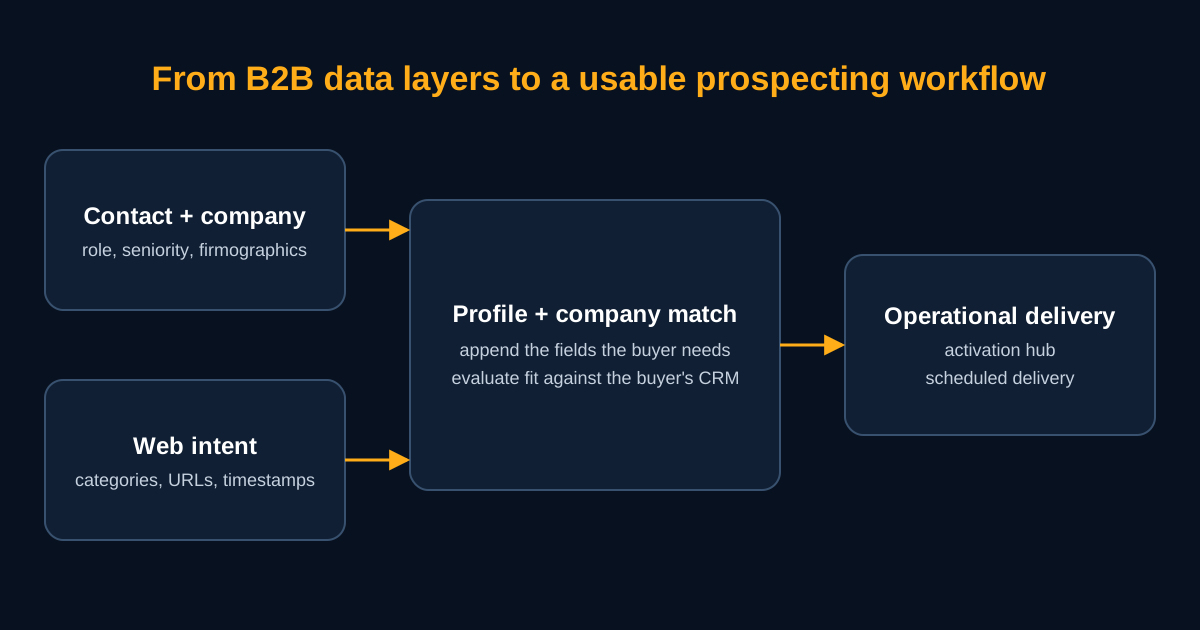
B2B contact and company data combine with web-intent signals for matching, enrichment, activation, and scheduled delivery
Catalog-backed flow from contact and company fields through profiling, matching, activation, and recurring delivery.

Which data layer fits the buying requirement?

LayerCoverageDocumented fieldsRefresh
U.S. B2B contacts200 million records, United StatesName, title, company, SIC, revenue, and employee countQuarterly
Global B2B contacts486 million records, global37-field schema including role, seniority, contact, company, technology, and location fieldsNot stated in the catalog
U.S. web intentUnited StatesHEM or MAID, intent categories, and URLsDaily
Global clickstreamGlobalURL, domain, category, device, IP, timestamp, and geographyReal-time

How should a buyer evaluate the stack?

Start with the account profile your team can act on, select the contact and company fields needed to build it, and then evaluate intent as a separate timing signal. Compare a sample against your own CRM for field completeness, usable matches, and delivery fit before planning a recurring workflow.

Documented workflow options

  • Data append service
  • B2B profiling and company match
  • Multi-channel activation hub
  • Scheduled and recurring delivery

What are the limitations and refresh caveats?

The catalog does not state a refresh frequency for the 486 million-record global contact database. It also does not document deliverability rates, response-rate lift, universal match rates, or a single delivery method for every B2B asset. Confirm those items for the selected asset during evaluation.

Permitted use and licensing

Talk to our team about applicable permitted uses, restrictions, and licensing terms before evaluation or activation.

Continue the buyer diligence

Request a B2B data evaluation

Frequently asked questions about B2B Prospecting

How should teams build a B2B prospecting data stack?

Combine contact and company fields with web-intent signals as separate layers. Use the contact layer to define and enrich target accounts, then use intent categories and URLs to help prioritize outreach. Evaluate field completeness, usable matches, geography, refresh expectations, and delivery fit against your own workflow.

Which B2B contact fields are documented in the catalog?

The U.S. asset includes name, title, company, SIC, revenue, and employee count. The global asset has a 37-field schema that includes role, seniority, email status, email, phone, LinkedIn URL, company revenue, employee count, current technologies, and person and company location fields.

How often is the B2B data refreshed?

The U.S. B2B contact asset is listed as quarterly, and the U.S. web-intent asset is listed as daily. The global clickstream asset is listed as real-time. The global B2B contact database refresh is marked TBD, so buyers should confirm its current cadence during evaluation.

What delivery workflows are documented?

The DaaS Solutions sheet lists data append, B2B profiling and company match, a multi-channel activation hub, and scheduled and recurring delivery. The global B2B contact database row lists S3 or internal delivery. Confirm the delivery method for the specific asset and workflow you are evaluating.

Where can buyers confirm permitted uses and restrictions?

Talk to the GSDSI team about the permitted uses, restrictions, and licensing terms that apply to the selected asset and planned workflow. The Data Asset Catalog does not contain a permitted-use field, so those terms should be reviewed separately before evaluation or activation.

✓ Opt-Out Request Honored via Global Privacy Control